
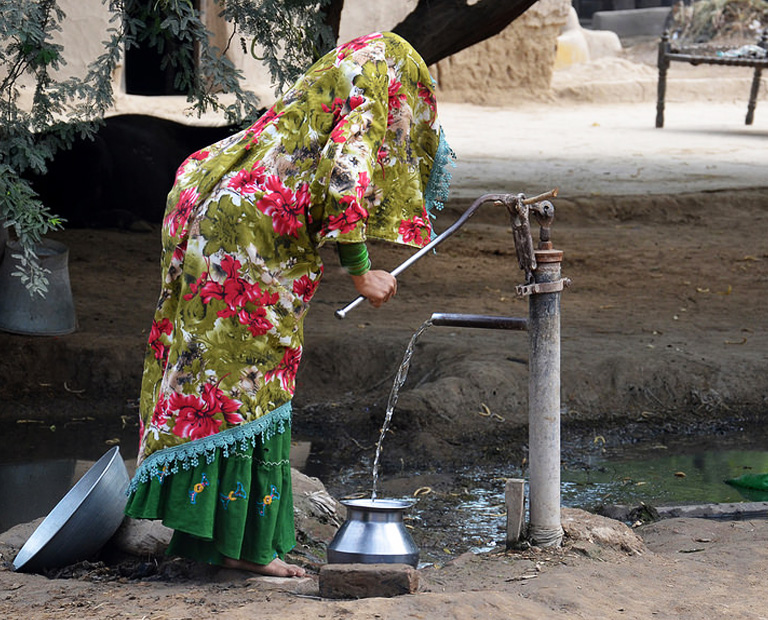
Water Crises
Water crisis in Pakistan and its solutions
Water security is an undeniably vital issue that establishes one of the greatest difficulties to Pakistan’s advancement.
With the expected population of 263 million in the year 2050, Pakistan needs to put genuine idea into how it will give sufficient water to agribusiness, industry, and human utilization even with quickly diminishing stores. Pakistan is among the countries that can run dry in near future. To mitigate this issue, Pakistan is moving forward to construct dam.
Other than the water storage problem, Pakistan has other challenges as well regarding the water sector. The main problem is definitely the water storage. Presently Pakistan has thirty days storage only. To increase this capacity; small, medium and large scale dams are required. Water logging and salinity also demolishing the agriculture sector of Pakistan.
The convenient way to solve this issue is lining of canals and the optimal use of water for agriculture. Pakistan should define the groundwater ownership, and legislation for licensing of groundwater, and increase the groundwater recharge for urban and rural areas under legal framework. Otherwise ground water depletion will lead to the severe droughts in Pakistan.
To control Water pollution including both the surface water pollution and groundwater pollution is a tough task to handle. The authorities have to work on the implementation of national environmental quality standards, incentives should be given to industrial sector in form of subsidies and tax relaxation against the installation of waste water treatment plants and to impose fine on the polluter pay plenty rule. Wastage of water needs to be controlled by adopting more crop per drop technologies for agriculture.
Laser levelling, drip irrigation and sprinklers can help to minimize water wastage at farm level. By drip irrigation, there will be no wastage of water through the evaporation. A sprinkler washes the leaves of plants and increases the photosynthesis. Pakistan has a long history of Inter-provincial disputes that did not allow the government to construct dams.
To resolve this problem, positive awareness should be raised, and agro-climating zoning should be preferred instead of provincial boundaries for water resources. Rather on the basis of land, it should be provided on the basis of crop. Different sectors require different quantity of water, so building the institutional capacity of government in order to quantify the demand by installation of meters and reduce the requirements by optimisation of its usage in all the sectors.
The experts affirm that the demographic transition and urbanization are the main causes of the crisis. To make these issues less severe, water sector demand the financial resources. Allocation of Public sector development program fund can help in improving the public sectors.
Mainstreaming environmental change concerns should help accomplish feasible improvement, including eco-framework conservation and proper administration and use of water.
Water crisis: Why is Pakistan running dry?
Pakistan could “run dry” by 2025 as its water shortage is reaching an alarming level. The authorities remain negligent about the crisis that’s posing a serious threat to the country’s stability, reports Shah Meer Baloch.

According to a recent report by the International Monetary Fund (IMF), Pakistan ranks third in the world among countries facing acute water shortage. Reports by the United Nations Development Programme (UNDP) and the Pakistan Council of Research in Water Resources (PCRWR) also warn the authorities that the South Asian country will reach absolute water scarcity by 2025.
“No person in Pakistan, whether from the north with its more than 5,000 glaciers, or from the south with its ‘hyper deserts,’ will be immune to this [scarcity],” said Neil Buhne, UN humanitarian coordinator for Pakistan.
Researchers predict that Pakistan is on its way to becoming the most water-stressed country in the region by the year 2040.
It is not the first time that development and research organizations have alerted Pakistani authorities about an impending crisis, which some analysts say poses a bigger threat to the country than terrorism.
In 2016, PCRWR reported that Pakistan touched the “water stress line” in 1990 and crossed the “water scarcity line” in 2005. If this situation persists, Pakistan is likely to face an acute water shortage or a drought-like situation in the near future, according to PCRWR, which is affiliated with the South Asian country’s Ministry of Science and Technology.
A water-intensive country
Pakistan has the world’s fourth-highest rate of water use. Its water intensity rate — the amount of water, in cubic meters, used per unit of GDP — is the world’s highest. This suggests that no country’s economy is more water-intensive than Pakistan’s.
According to the IMF, Pakistan’s per capita annual water availability is 1,017 cubic meters — perilously close to the scarcity threshold of 1,000 cubic meters. Back in 2009, Pakistan’s water availability was about 1,500 cubic meters.
The bulk of Pakistan’s farmland is irrigated through a canal system, but the IMF says in a report that canal water is vastly underpriced, recovering only a quarter of annual operating and maintenance costs. Meanwhile, agriculture, which consumes almost all annual available surface water, is largely untaxed.
Experts say that population growth and urbanization are the main reasons behind the crisis. The issue has also been exacerbated by climate change, poor water management and a lack of political will to deal with the crisis.
“Pakistan is approaching the scarcity threshold for water. What is even more disturbing is that groundwater supplies — the last resort of water supply — are being rapidly depleted. And worst of all is that the authorities have given no indication that they plan to do anything about any of this,” Michael Kugelman, South Asia expert at the Washington-based Woodrow Wilson Center, told DW in a 2015 interview.
Qazi Talhat, a secretary at the Ministry of Water Resources, told DW the situation is “scary” for Pakistan.
Water scarcity is also triggering security conflicts in the country. Experts say the economic impact of the water crisis is immense, and the people are fighting for resources.
Climate change
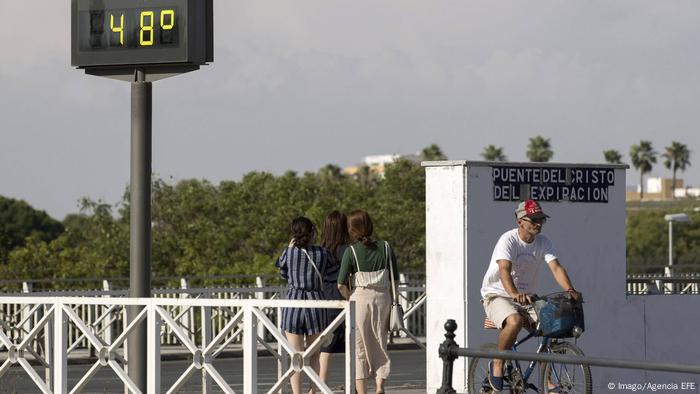
Water scarcity in Pakistan has been accompanied by rising temperatures. In May, at least 65 people died from heatstroke in the southern city of Karachi. In 2015, at least 1,200 people died during a spate of extremely hot weather.
“Heat waves and droughts in Pakistan are a result of climate change,” Mian Ahmed Naeem Salik, an environmental expert and research fellow at the Institute of Strategic Studies in Islamabad, told DW.
“The monsoon season has become erratic in the past few years. The winter season has shrunk from four to two months in many parts of the country. On top of it, Pakistan cannot save floodwater due to a scarcity of dams,” Salik said. “At the time of Pakistan’s birth in 1947, forests accounted for about 5 percent of the nation’s area, but they have now dropped to only 2 percent. Pakistan must invest in building water reservoirs and plant more trees,” he added.
Read more: How climate change is aggravating Pakistan’s water crisis
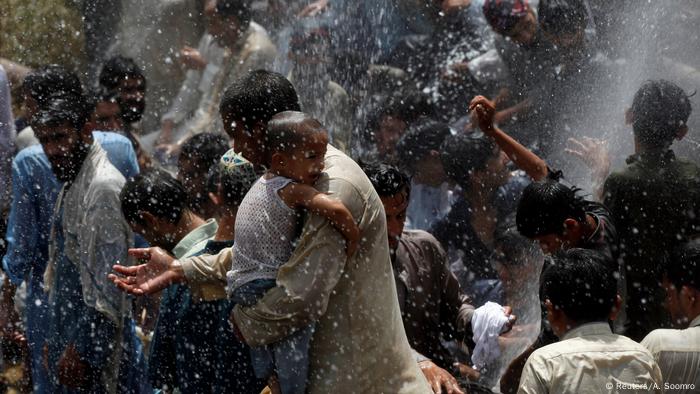 Water scarcity in Pakistan has been accompanied by rising temperatures
Water politics
The Tarbela and Mangla dams, the country’s two major water reservoirs, reached their “dead” levels last week, according to media reports. The news sparked a debate on social media over the inaction of authorities in the face of this crisis.
“We have only two big reservoirs and we can save water only for 30 days. India can store water for 190 days whereas the US can do it for 900 days,” Muhammad Khalid Rana, a spokesman for the Indus River System Authority (IRSA), told DW.
“Pakistan receives around 145 million acre feet of water every year but can only save 13.7 million acre feet. Pakistan needs 40 million acre feet of water but 29 million acre feet of our floodwater is wasted because we have few dams. New Delhi raised this issue with international bodies, arguing that it should be allowed to use the western rivers because Pakistan can’t use them properly,” Rana said.
In 1960, the World Bank brokered the Indus Water Treaty (IWT) that gives Pakistan exclusive rights to use the region’s western rivers — Indus, Jhelum and Chenaub — while India has the authority over three eastern rivers.
The Pakistani government says New Delhi is not fulfilling its responsibilities under the IWT as it voices concerns over India’s construction of new dams. New Delhi is building the Kishangaga hydroelectric plant in the north of Bandipore in India-administered Jammu and Kashmir region. In May, Islamabad approached the World Bank complaining that India violated the IWT by building the dam on a Jehlum River basin, which it lays claim on.
Kugelman says that the Pakistani authorities need to step up efforts to overcome the water crisis, which is partly man-made. “First of all, Pakistan’s leaders and stakeholders need to take ownership of this challenge and declare their intention to tackle it. Simply blaming previous governments, or blaming India, for the crisis won’t solve anything. Next, the government needs to institute a major paradigm shift that promotes more judicious use of water,” Kugelman emphasized.